

Breathing Techniques
Breathing deeply is one of the most effective ways to regulate your heartbeat, calm the nervous system, and reduce stress.
Under Stress: Breathing becomes shallow and chest-focused, raising heart rate and blood pressure.
To Relax: Focus on expanding and relaxing your lower belly. Once comfortable, shift attention to the middle belly—between the navel and diaphragm.
Place your hands on different areas of the belly to feel
the movement.
Many breathing techniques can be used to balance the heart / mind connection. Among them, I recommend cardiac coherence and the 4-7-8 technique along
with Tapping.

Cardiac Coherence
Cardiac coherence refers to a balanced and efficient state of the heart and body, achieved through a specific breathing technique that synchronizes the heart’s rhythm with the breath.
This synchronization aims to reduce stress and promote a feeling of calm and balance, ultimately enhancing overall well-being.
Some of the key benefits are: lower blood pressure, improve heart rate variability (HRV), enhanced immune function and emotional regulation, better sleep quality, improved autonomic nervous system, increased resilience.
Practise 3 times a day, ideally for 5 minutes:
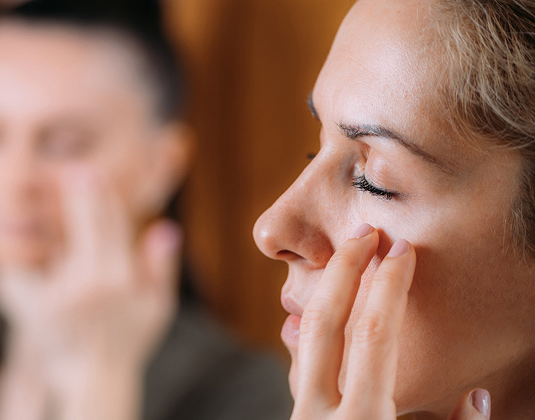
- While gently tapping on the side of your fingers (Tapping acupuncture points), inhale slowly through the nose for 5 seconds.
- Exhale slowly through pursed lips for 5 seconds, gently drawing in the belly.
- Visualize inhaling positive energy and appreciation, and exhaling stress.
4-7-8 Technique
The 4-7-8 breathing technique is a simple yet powerful breathing exercise developed by Dr. Andrew Weil, based on ancient yogic pranayama practices.
It involves:
This technique helps regulate the autonomic nervous system and has both immediate and long-term benefits.
What to do:
- Inhale through the nose for 4 seconds while inflating your belly.
- Hold the breath for 7 seconds.
- Exhale slowly through the mouth for 8 seconds - or longer.
- Visualize taking in clarity and releasing tension.

Benefits
 Activates the parasympathetic nervous system: helps your body shift from a state of stress (fight-or-flight) to relaxation (rest-and-digest).
- It slows the heart rate and calms the nervous system, reducing cortisol and adrenaline.
- Lowers the heart rate and blood pressure.
- Improves sleep quality: it reduces mental chatter.
- Increases focus and emotional control.
Recommended Self-help Reads

 The Science Behind Tapping – Peta Stapleton
- Matrix Reimprinting Using EFT – Karl Dawson
- The Body Keeps the Score – Bessel van der Kolk
- When the Body Says No – Gabor Maté
- Waking the Tiger – Peter Levine
- The Biology of Belief – Bruce Lipton
- EMDR Therapy: Basic Principles, Protocols, and Procedures – Francine Shapiro
- The Key to Your Energy – Natacha Calestrémé
- The Four Agreements – Don Miguel Ruiz
- The Gifts of Imperfection – Brené Brown
Our Deepest Fear – Marianne Williamson
Our deepest fear is not that we are inadequate.
Our deepest fear is that we are powerful beyond measure.
It is our light, not our darkness, that most frightens us.
We ask ourselves, who am I to be brilliant, gorgeous, talented, fabulous?
Actually, who are you not to be? You are a child of God.
Your playing small does not serve the world.
There is nothing enlightened about shrinking so that other people won’t feel insecure around you.
We are all meant to shine, as children do.
We were born to make manifest the glory of God that is within us.
It’s not just in some of us; it’s in everyone.
And as we let our own light shine, we unconsciously give other people permission to do the same.
As we are liberated from our own fear, our presence automatically liberates others.
— Excerpt from A Return to Love: Reflections on the Principles of A Course in Miracles
A Little Story
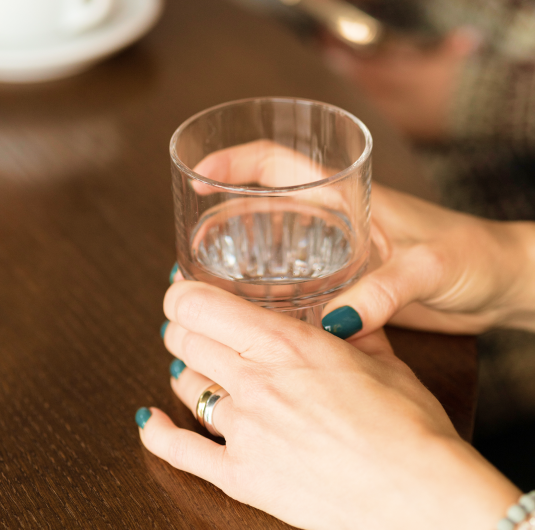
While teaching stress management, a psychologist held up a glass of water. Rather than asking whether it was half full or half empty, she smiled and asked, “How heavy is this glass?” Answers ranged from 220 to 550 grams.
She replied, “The actual weight doesn’t matter. It depends on how long I hold it. A minute? No problem. An hour? My arm will ache. All day? My arm will go numb. The weight stays the same, but the longer I hold it, the heavier it feels.”
She added, “The stresses and worries in life are like this glass of water. Think about them briefly, and it’s manageable. Think about them all day, and they can
feel paralyzing.”
Remember to put the glass down.